For newcomers

Thursday, September 27, 2018

Inequality

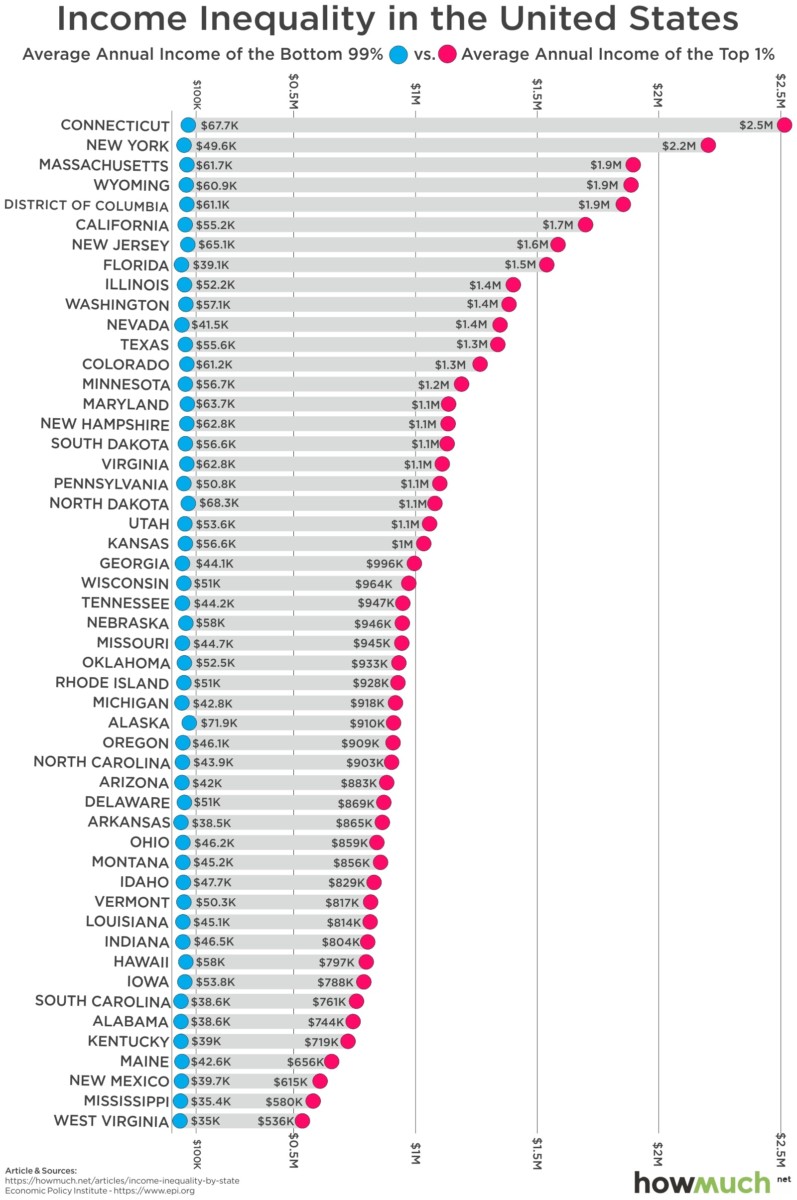
Here's a little factoid for us progressives to ponder: Income inequality appears to be generally worse in Blue States than Red ones:


What does that signify? There may be many explanations, but whatever they are, we Blues haven't done much to reduce inequality. We know that on a national level, but we can blame that on Republican resistance. But Massachusetts? New York? California? 


Wednesday, September 19, 2018

(Where the right is not wrong, part 3): White males are suffering

The Progressive Left among which I count myself, has shone a spotlight on the evils of racism, especially against African-Americans. Very few people now deny the long historical record of brutality, and a large majority even recognize the continuing injustices in the present day. But that focus has blinded us to the real suffering of whites and males. 
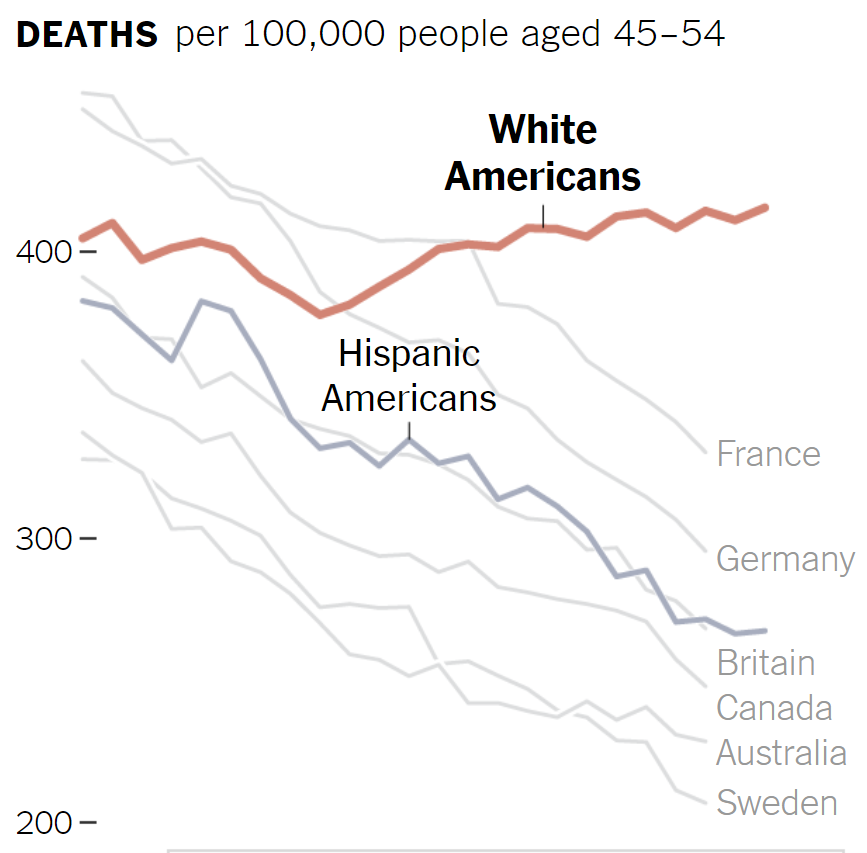
This burst into our consciousness – or should have burst – two years ago when Deaton and Case found that between 1999 and 2014, the death rate among white adults with a high school education rose by twenty-two percent. They trace the causes mostly to suicides and afflictions stemming from substance abuse: alcoholic liver disease and overdoses of heroin and prescription opioids. “Only H.I.V./AIDS in contemporary times has done anything like this,” Deaton commented.  If those words aren’t enough, here’s a picture:

.
The liberal response has been largely unsympathetic. We haven't paid much attention to this study or this group. Hillary Clinton largely ignored them in 2016. We often dismiss them as ignorant and uneducated. We would never say that about any other group – immigrants or blacks or muslims – because that would be victim-blaming. But we generally don’t see undereducated white males as victims: we see them as the beneficiaries of centuries of racism. Yet they apparently don’t feel like beneficiaries of anything, and they’re dying.
We do offer them money – we say our welfare-state programs will protect them from poverty. Then we are baffled when they don’t embrace us. Like Robert Frank in his popular book, we cannot figure out “What’s the matter with Kansas?” But we should know: money without respect is no balm. We do know that abstractly: the watchword of liberalism is respect. But we have this hole in our sight.
Conservatives don’t seem to have the answer either. Most of the hot spots of white mortality are in conservative, Republican areas – West Virginia, Kentucky, Kansas indeed, much of the West.
William Julius Wilson, perhaps the most important sociologist of black poverty of the past half century, made this point long ago: whatever the answer is, it has to include everyone. Solutions targeted at blacks will never work, because they divide the society, creating resentments that lead to exclusion rather than inclusion.  Whites need to be included in the solutions.

Monday, August 6, 2018

Winning is not enough

As a liberal, I am deeply upset by the direction of the country. But I don't think beating Trump will save us. I believe deeply that we have to do something harder: to build understanding across the political divide.

But I’m not getting much traction. Almost everyone on both sides believes it’s more important to win. They all think their view of the world is right, and that the future depends on their triumph.

I’m saying that victory, by itself, won’t do it. We need to demand more of ourselves.

I am personally offended by Trump actions almost every day, and I feel he is extremely dangerous for our future. I think he has to be stopped; it’s an emergency. He is destroying the foundations of our democracy, and indeed of the international world order that has slowly increased prosperity and safety for everyone for decades.

And yet, if all we do is to stop him, 40% of the country will be enraged and will battle back with every weapon they can find. In this kind of polarized environment, the rules of civilization no longer restrain people. Though I feel that the situation is so bad that we have to stop Trump almost no matter what it takes, the other side -- the solid 40% of Trump supporters -- feels just as passionate. This is how conflict spirals out of control.

Western democracies, after a long period of general accord on the principles of Keynesianism and the welfare state, have profoundly split. The populist wave, which has gained significant strength across the board, rejects the advances of the postwar period, is hostile to multiculturalism and globalization, and has little faith in existing governments. Populists feel they have ignored and marginalized for too long, and they are full of passionate intensity in their search for power.

Since these nations are, after all, democracies, we cannot ignore this backlash; nor should we. We liberals have not done the work of understanding the sources of the discontent. We are too quick to accept facile explanations that demean the populists and deny their legitimacy as citizens: we call them ignorant, racist, “deplorable.” They feel, with much justification, that if they lose this battle we will simply sweep them aside. They will fight with fury to prevent that, and they will continue the war even if they lose a battle.

It’s worth looking at history for lessons. Here’s one instructive contrast: After World War I the victorious Allies punished Germany and treated it with contempt; it rose rapidly from a crushing defeat to launch another wave of destruction. After World War II, by contrast, we helped Germany to rebuild, and major efforts were made to bring it back into the large European community; it soon became a major force for progress and liberalism.

Or we can look at our own Civil War: when the Union won, Abraham Lincoln pleaded for reconciliation in his Second Inaugural address: “We are not enemies, but friends. We must not be enemies. Though passion may have strained, it must not break our bonds of affection.” His assassination, however, unleashed a vengeful torrent of victors against victim – with the result that much of the South remains to this day alienated, hostile to the dominant liberal order.

We have to win, but we have to win in a way that promotes reconciliation. We have to call, as Lincoln did, on “the better angels of our nature” even in the midst of a battle that may determine the fate of the earth. We need to listen to our enemies, to understand their grievances, and to include them in building our common future. It demands hard work instead of facile triumph. But if that’s asking too much from us, we may not get a chance to build at all.

Wednesday, August 1, 2018

A theory of polarization: four frames

A brief statement of my theory of political polarization - supported by my recent survey. It does a good job of identifying the basic differences between Republicans and Democrats.
Four basic “frames”, or ways of seeing the social world, have emerged in the West over the last few hundred years. Each has a different focus:
  • Tradition: emphasizes shared traditions and beliefs, focusing heavily on churches.
  • Freedom: emphasizes individual liberty and responsibility, focusing on free markets.
  • System: sees society as a system of large institutions – corporations, unions, and government, guaranteeing stability and fairness.
  • Diversity: seeks full inclusion and interaction among different cultures.
These four frames capture key electoral divisions and show up strongly in my survey data. Tradition is the orientation of religious and culturally conservative Republicans, and Freedom that of more libertarian Republicans. On the Democratic side, System is the frame of “old” liberals who support the welfare state and unions, while Diversity is the more “progressive” frame within the party, focused on multiculturalism and racial justice.
The important thing is that these orientations are not fads or temporary products of political sloganeers, nor are they just personality types. They are competing visions of a good society that have emerged from a long arc of Western history.
The Traditional frame has characterized most human groups since the dawn of history. It believes that societies work only if everyone shares a basic sense of right and wrong across all domains of life. That sense must come from some combination of tradition and religion shared by all; and it has to be strongly inculcated in everyone, because failure to do so threatens the order. This shared belief provides strong stability and confidence: when you cross paths with others, you can be pretty sure that they will see things the same way you do and will act as you expect.
The problem with the Traditional view is that it doesn’t give a way of dealing with people who don’t share your religion and traditions. So when Traditionalistic groups have to deal with outsiders, they usually fight. The religious wars of the 16th century in Europe were so bloody that societies at last moved to the next step: an agreement to tolerate differences and to accept individual freedom.
The Freedom frame emerged, in the West at least, during the 17th and 18th centuries with an acceptance of the moral autonomy of individuals – a centerpiece of the emergent Protestant faiths – and, with it, the importance of personal responsibility. From this perspective, it doesn’t matter what tradition or religion others come from: they can do whatever they want in private. All that matters is that they follow a few basic rules in public that we have agreed to – a “social contract.” Otherwise we stay out of each other’s way, live and let live.
The early modern era combined the Tradition and Freedom frames: people maintained their traditions and religion in their private spheres, and made impersonal deals in their public lives. These two frames have now allied in the Republican party. The alliance is not always comfortable: libertarians, who emphasize Freedom, are often in tension with the Traditionalist wing of the party. Nevertheless, both represent a “conservative” orientation in that they reflect views of society that have long histories and fully-developed institutions of social order.
The Industrial revolution complicated things further. As society became more complex, big organizations began to take space from markets. Big businesses were able to produce efficiently on larger scales than pure markets; and government grew to regulate and coordinate them. A view developed that saw society not as atomistic individuals and tribes making deals with each other, but as systems of rules and organizations. Nations throughout the West organized around three key institutions that grew rapidly in the mid-20th century: corporate bureaucracies, “big government,” and unions. This "System" view was the framework for thirty years of great prosperity and social advances throughout the West after World War II..
Starting in the late 1960s, however, this view lost support: confidence in those big institutions has declined sharply throughout the advanced nations, and “bureaucracy” has come to be seen as a bad word rather than a good one. In its place, there has developed a frame around Diversity. It emphasizes the value of cultural differences and seeks to eliminate the status differences that have kept some groups subordinated to others. Personal identities have become much more fluid – less based on traditional roles, more constructed from engagement with a range of others. As the newest of the four frames, it is still an idea more than a program, with the least experience in actually building large-scale societies.
In the Republican party, the tension between Tradition and Freedom sometimes bursts out, for instance in battles over economic protectionism or around Traditionalists’ impulse to impose their moral codes. The Democratic party is often torn by tensions between the Sytem and Diversity views. Bernie Sanders, for instance – an old System guy, focused on government programs – has trouble connecting to the multiculturalists. Nevertheless, the two strands are broadly allied because they reflect views of society that have emerged only within the last century, and in many ways are not yet fully developed. Both are building their vision around partially-formed aspirations rather than concrete images from the past. The Diversity view, in particular, is still in an early stage, with many unsolved problems; it is more an impulse than a program.
These changes have caused much turmoil and disruption. Some parts of Western societies have responded “conservatively” – wanting to go back to the hybrid of Tradition and Freedom frames that marked the early Modern era, roughly the 17th to the mid-19th centuries in the West. The more urban and globalist groups have wanted to push forward in creating societies of greater participation and diversity, even when they don’t quite know how to do it. And that split has led to our current polarization. The contest between these basic perspectives will determine our future.

Friday, July 27, 2018

Have opinions shifted since the election?

I wanted to know whether all the brouhaha since the 2016 election has led to any fundamental shifts in views. The answer, in short, is: maybe a little; we should raise a caution flag but not send out the emergency rescue vehicles.

I conducted national surveys in  2014-15 for a study of trust, and ran another one last month (June), with a similar sampling method and some of the same items. The earlier surveys focused particularly on views of diversity. I was surprised to find at that time that there was near-consensual support for what I called “strong diversity” – not just tolerance, but belief in the value of active multiculturalism. Two of those items, which were  repeated in the new round, were:

  • People from other places and cultures help us to grow, we should learn from them.
  • People should be encouraged to celebrate their cultural, ethnic, religious, and linguistic differences.
In the first round, 78% agreed with the first and 83% with the second. I found this quite surprising: these items seemed to me to touch directly on the culture wars and the contested notion of multiculturalism. When I wrote them I expected a lot of negative responses. Yet it appeared they had in fact become very widely accepted as the right way to think and speak.

Some might object: Well, but this is just people saying what they think they ought to say, to avoid feeling guilty about their real beliefs. If that were the case, one might expect that Trump’s election would have taken the lid off: people might feel it was now ok to voice their real objections to multiculturalism.

The results suggest a little of this, but only a little. There was some decline on both the strong diversity items above: 4% on the first, 6% on the second. There was a 3% decline on “I expect the government to ensure that diverse people are included and respected.” None of these proves much alone, but together they suggest a very small reduction in endorsement of multiculturalism. Yet support for it remains very high: this is far from an unleashing of a torrent.These add to a sense of a small conservative shift, at least verbal.

There were similar decreases in some items on government activism: 3.5% that government should regulate market forces; 2% on wanting government to ensure that everyone is provided for. These add to the impression of a quite small conservative shift.

Altogether, I think the Trump phenomenon has enabled some people with conservative leanings to express more openly their skepticism about multiculturalism. But it has not much shifted the center of gravity, which continues – again, to my surprise – to endorse, the multiculturalist view at an over 75% rate.

Two items of a different sort do trouble me. Two of the biggest declines were a 9% drop in “We all depend on each other, so we have work together,” and a 7% drop in “It is important to try to understand people we don't agree with.” When I put these together with a lot of other evidence, I see gathering evidence of increasing polarization – not wanting to deal with political disagreement.

One way of reading the whole pattern (including some evidence I haven’t detailed here) is that both liberals and conservatives are moving a bit towards more openness in their views, less willing to shade their opinions to meet a perceived unifying consensus. Openness is good, but rejection of a desire to seek agreement is, I think very dangerous. These data don’t show a crisis, but a kind of polarization that – as I have indicated in other posts – could be a grave threat to our democracy.

Sunday, July 22, 2018

Why Trump supporters stick with him


Liberals are continually amazed that Trump's supporters stick with him no matter what outrages he commits: we keep thinking, "This time he's gone too far," and we keep being wrong. Here's why:

1. Trump voters, in the main, think the system is rigged against them.

81% of Trump voters say that “Compared to 50 years ago, life for people like me is worse” – (vs only 19% of Clinton voters).

2. When people feel the system is rigged against them, they vote for whoever promises to smash it.

That’s Trump. And he’s doing quite a good job of smashing it. If that’s what you want, he’s your man.

3. When those who are identified with the rigged system -- that is, us -- act outraged, that means – for Trump voters – that he must be doing the right thing.

Therefore: The more outraged we are, the more they support him.

Monday, July 16, 2018

Where the Right is not wrong, part 3: The value of personal responsibility

Below: Part 1: Experts don't know everything
              Part 2: regulations are often burdensome

One of the weird things that result from polarization is that perfectly sensible ideas become distorted  by association with one side. The Right has taken ownership of the idea of “personal responsibility”. For the Left, that now smells of a cover for not wanting to help those in need. Reds seek to cut programs like welfare because, from their perspective, they want to encourage personal responsibility; from our Blue point of view, that just leaves the poor in the lurch and robs  them of opportunity. We believe government has a responsibility to help, and we do not believe that voluntary charity from communities or individuals is adequate. This disagreement quickly spirals into mutual recriminations, with the Right accusing the Left of coddling the poor just to win votes and power, and the Left accusing the Right of covering avarice and heartlessness under a false value of responsibility.

But let's step back for a moment. Personal responsibility is something we all value. Blues hope as much as Reds that our kids will learn this value. None of us believes that a good society is one in which people laze around waiting for government handouts. We all want a society in which people are engaged in meaningful work and can support their families and communities.

And we should recognize that none of us really knows how to get there. Even if government programs are critical for helping the disadvantaged - which we Blues do believe - we haven't solved the problem of what happens after that. There have of course been many theories and experiments in transitioning people from welfare, but I think it's fair to say that none has been a ringing success. But neither has relying on local community and personal responsibility.
The sociological view is that we need both. Government cannot operate effectively without support from communities, and communities are not sufficient to deal with the problems of complex societies without government. Is it so hard to keep both things in mind at once?

We do know that the Great Society programs of the 1960s and 1970s have not succeeded in improving the lives of many poor and minority people. Some Blues blame it on racism, which is a rather vague category; but even if it's true, that's exactly the point. Regulations cannot by themselves overcome racism or other forms of social resistance. Regulations work only when they operate together with growing social consensus.

We if the Left don't have much to say about how to build such a consensus. Faced with crises in government-based welfare programs, we generally stick to a one-note reply: do more of the same - increase the force and scope of the regulations. But much evidence indicated that this only increases the force and scope of the resistances and evasions. We have paid far too little attention to complementary strategies of community mobilization, especially among whites and the more affluent. And we have consistently underestimated the difficulty of building self reliant communities among the disadvantaged.

It certainly seems clear that personal responsibility is not enough: benevolence from the dominant community, and preaching the value of self reliance to the poor, are inadequate responses to the severe issues of inequality and poverty. But community and self reliance are good and necessary and should be part of the conversation.