For newcomers

Wednesday, February 5, 2020

Can love win?


There is a strong impulse on the Left now, which I certainly feel myself, to fight back against Trump with all we have. We hate what he’s doing. We feel that our most basic moral beliefs are being violated, the things we care about being destroyed; so we want to join together in battle to stop it. It’s a natural reaction, a human reaction, one that has been  nearly universal throughout history.
There’s also an opposing impulse exemplified by many people we admire: an impulse towards inclusion and openness and humility – towards love over hate, peace over war. We believe deeply in those virtues. But in order to fight effectively, we feel we have to deny them. We have to define some people as outside the boundaries, as evil. We have to close ourselves to the possibility that they could have some good in them. We have to stereotype them, see them as a faceless and unified enemy. Our assumption is: first we have to win, then we can love.
The problem that we too often forget is that the other side feels the same way. Partisans on the right now believe that we are evil. If you read both sides, you see identical language:  If they can get away with lying and and cheating and manipulating, then we have to start doing it too. 
This tit-for-tat spiral of mistrust and hatred can lead to no good end. No matter what our politics, it is vital that we end it. All will lose while it continues.
Is there an alternative to fighting? Can love win?
I was much moved some years ago by Bishop Tutu’s sermon in Trenton, New Jersey, on the theme: Everyone stands in God’s light. “Everyone,” he insisted: “Idi Amin – he stands in God’s light! Adolph Hitler! And …” (with a little smile - this was in 2006): “George Bush!” (There was nervous laughter in the largely African-American congregation.) “Everyone!” 
Today he would surely continue: “Donald Trump - he stands in God’s light!” And for committed partisans on the right, he would add: “Hillary Clinton, too! And Elizabeth Warren!”
This is strong medicine: it attacks our self-righteousness at the core, it undercuts our certainties. How can I choose, how can I act, how can I stand up for my beliefs, if I believe that God equally embraces Trump and Hillary, me and my most detested opponents? 
Of course, paradoxically, Tutu is also a fighter. He has fought a long battle against apartheid and racial oppression; he has also fought for homosexuals and for  other excluded groups. He is one of those rare souls who has sacrificed his own comfort and safety for a lifetime to battle oppression. And yet at the same time he is something far rarer: someone who insists on the essential dignity and worth of the oppressors. That is an extraordinary triumph of the spirit.
Extra-ordinary as this is, he shows us the way to salvation - secular as well as spiritual. As walking requires two legs, so human progress requires two impulses: including and excluding, fighting and reconciling. Neither alone can work.
If you merely fight for what you believe, you may lose. And what if you win? You will have made deeper enemies of your enemies. They may never forgive you. They will continue to fight you by whatever means they have – open or hidden. They  will resist every move you make. If you suppress them sufficiently they may go underground for generations, centuries, millennia. The fire will continue to smoulder, like Serbs and Croats since the 10th century, Muslims and Christians from the time of the Crusades – until a little stirring leads to an explosion of hate. Fighting strengthens its own antithesis and undermines its own intentions.
But not fighting is  not an alternative. If you merely love, then not only will you lose, giving oppressors a clear field to exert their will; you will also sacrifice your own dignity, which depends centrally on the willingness to to take a stand for what you believe in.
So now what?
There’s a tactical argument for love. Democrats are torn now (February 2019) between candidates who would fire up the base for a fight – Warren and Sanders – and ones who would reach out more to undecided voters – Biden, Buttigieg. The first pair might add votes from some passionate Democrats who would not turn out for the latter, while the second pair might add votes from the 15% or so who say that they have not yet made up their minds. Which is more likely to win? Highly seasoned political professionals differ, but odds are that reaching out does better than consolidating the base. The Democratic campaign of 2018, following a reaching-out strategy, was highly successful; Jeremy Corbyn’s narrowly ideological 2019 campaign in England was catastrophic. So hardheaded realism suggests that simple fighting is not the best approach.
There’s also a longer-term strategic argument. If the Democrats win the election, Left partisans will feel energized and inspired, will feel good about themselves, and will push strongly for expansion of liberal policies. But there will be a strong impulse on the right to fight back. They will feel that their most basic moral beliefs are being violated, the things they cared about being destroyed. They will fight with whatever means they have – open or hidden – and resist every move we make. We will be further infuriated by the conservative resistance. There will be a continuation of the polarization and paralysis that have  marked the last few decades. The vicious circle will deepen.
The hope now lies in this: that there is actually much that the American citizenry can agree on. There are many policies with support from large percentages of the population, but that can’t get done because of the current spiral of mistrust. Polls indicate that 83% of the public - including 70% of conservatives - agree that “We need to invest more in the development of renewable energy sources like solar and wind.“(2) 75% favor higher taxes for the ultrawealthy.(3) Over 70% support a voluntary Medicare buy-in for all.(4) Similar majorities say the government should be involved in ensuring a basic income for those 65 and older (71 percent), and helping people get out of poverty (67 percent).(5) On guns, immigration, even abortion there is similar near-consensual support for significant policy advances.
Yet these consensual policies that are languishing because neither side wants to give the other a victory. Because both sides are intent on winning, neither can actually make progress. Every move spurs a counter-move; every change in administration strives to undo what the previous one did.
That’s where love comes in. If we turn up  the volume of our impulse to generosity and inclusion – if we see Republicans as standing with us in God’s light – we can find vital areas of progress that all of us believe are right and good. We can start to move. And it becomes far more likely that having started we will find more directions for walking together. 
Concretely, I’m talking about developing citizen conversations in which Republicans and Democrats explore issues together and search for those areas of shared belief. This would defang the most committed partisans who now dominate the political scene because they are energized to come out in primaries and by-elections; it would give a voice to the large majorities who agree on many issues. We know this can work from many examples at local  scales. Now it is urgent – very difficult, but urgent – to reinvigorate citizen politics through deep engagement at the national level.
This is not a call for moderation, or even civility; it’s not about compromising or being nice. We must always be true to who we are and what we believe. Rather, I’m proposing a search for real agreements: areas in which those whom we now see as enemies share our beliefs. There are a lot more of those than we think. But only love – openness, humility, inclusion – can find them; and thus, in the end, only love can win.


=============================
1. In the 2016 election, the Democrats aimed their appeal at the “median voter” while the Republicans aimed to activate their base. In that case, at least, the former strategy did better. See Hemphill, Libby, and Matthew A. Shapiro. 2018. “Appealing to the Base or to the Moveable Middle? Incumbents’ Partisan Messaging Before the 2016 US Congressional Elections.”
3. Fox News and Politico polls are in this same range: see https://politi.co/2qhEApc
5. Pew, 2017: http://bit.ly/350rzzL

Monday, December 23, 2019

Towards a Progressive frame

Progressivism as a framework for political action is quite new and immature. It is time for it to grow up, and quickly.

The Progressivism I mean here is the strand on the Left that focuses on gender and race inequities rather than class. This is a shift: the liberalism of the Democratic party was forged to a large extent by class divides, with a strong foundation in the labor movement. The progressive wing is often in tension with that tradition and represents a major cultural development.

The basic impulse at its core is a feeling that it is good to widen the scope of inclusion, to engage with people who are different. That’s a very radical idea. Human civilizations for almost all of their ten thousand years or so have survived by demanding that members abide by a code of right and wrong based on shared traditions; outsiders could join, at best, only if they were willing to learn the code. Progressives passionately reject that idea: they feel that any such society suppresses creativity and individuality and perpetuates injustices of power and privilege.

The notion that blacks, and muslims, and women, and gays, and all the varieties of gender identity should be fully included in society – that they should feel comfortable in expressing their distinct identities – is  a powerful wizardry, with the hope and promise of transforming society from its age-old hierarchy of privilege into an equal community of respectful interaction.

But this progressive ideology is also very one-dimensional and incomplete. It rejects wholesale the order of the past and demands a radical break. Since straight white males have been the highest-status group in the past, it would strip them of legitimacy. Anything the marginalized groups say carries the truth of oppression. Those of higher status can only keep out of the way, show respect, “check their privilege,” in order to create room for the marginalized to develop their power and pride.

Like all developing ideologies, this runs into all kinds of problems in practice – and not just because of resistance from the straight white males. It leads into mazes in trying to define right and wrong. Most obvious are the various tensions among the many marginalized social-identity groups. What do we as progressives make of the frequent homophobia among black men? Or the common norms of treatment of women in Muslim cultures that seem to us demeaning? Does the feminist critique of toxic masculinity extend to black men as well as white ones?

These kinds of questions, in my experience, make progressives – especially the white male subset – extremely uncomfortable. No one wants to talk about them. We feel there are traps wherever we turn – someone will be mad, or hurt; someone will guilt-trip us. And these problems have grown only more difficult as the moral claim of the status-oppressed has been raised by increasing numbers of groups, such as multiplying sexual identities.

Then there is the problem about where to draw the moral boundaries. Many of the issues raised by Black Lives Matter are uncontroversial: virtually, Right or Left, everyone thinks that police shootings of unarmed black children are wrong, and most accept that there is good reason for a sense of outrage. But Black Lives Matter has also focused on much more contested and dubious issues. When a few activists argued that a painting of Emmett Till’s coffin should be removed from an exhibit and destroyed, merely because it was painted by a white woman, I and many of my friends felt this was going too far. When #MeToo went after Aziz Ansari for being sexually pushy with a woman who had pursued him and gone back to his apartment with him, the Left was similarly divided. Those more to the Right, meanwhile, may be horrified by police shootings of unarmed people and by Harvey Weinstein'a predatory sexuality -- but they think that the frenzy over cases like Ansari are ludicrous. It undermines their support for the broader issues.

We progressives have not yet worked these things through. I find it heartening that there has been real debate among progressives on the Ansari case, but all too often those who disagree with the more extreme claims of the activists are silent because they cannot articulate a clear view that challenges the moral claims of marginalized people without disrespecting them.

Finally, there are problems and injustices that are about issues other than status inequality and marginalization. The narrow progressive ideology has trouble dealing with them -- especially with the issue of class. Economic inequality is unquestionably a major threat to our future. But the problem is that many straight white males are also poor. They are at the bottom of society; they feel excluded from opportunities; some 40% of them have spent time in jail; they feel deeply uncomfortable in elite settings of universities and the halls of power. Yet in the progressive ideology, they are defined as the oppressor. Somehow, they are blamed for racism far more than liberal rich whites – even though the rich whites I know live in almost exclusively white neighborhoods and send their children to heavily white schools. All of this blurs the problem of economic inequality when seen through a progressive lens. As ideologies tend to do, this has begun to provoke schisms within the left: Bernie, who represents the older form of liberalism, is seen by many Progressives as insufficiently “woke”.

Or climate change. One can see a racial dimension in the climate issue, but it is surely not mainly about that. We all suffer from it, all our children will suffer more. If any issue should be able to draw together peoples and nations, this is it. But emphasizing the racial dimension undermines this unity and weakens the movement.

In other words, the simplicity of the progressive ideology – the ideology of turning the status hierarchy on its head, so the last become first – makes many moral judgments all but impossible, blinds us to many important issues, and fragments what should be a dominant movement. The moral certitude of this view makes it effective in mobilizing passions, but ineffective for building sustained action.

We need a more complex frame. Such frames develop through practice and reflection – through patient debate and dialogue about experience. The process requires more humility than we progressives typically show. We do not know all the answers. We are very uncertain about what the good society might look like in many aspects. And we have no idea how to get from here to our goal of a fully inclusive society. We are divided among ourselves, and we often drive away potential allies – those who may be on the same road but not at the same point. Like many radical movements of the past, we are too often stuck on ideals; we fail to incorporate the demands of practice into a complete framework of progressive thought.

A small group of young people I know have formed a group to discuss the discomforts and dilemmas of the Left. They call themselves “Apostates” – meaning that they don’t subscribe to orthodoxies. They share the basic impulse of inclusion, but they reject the constrictions of ideological purity. They begin by airing views that are unpopular: some are gun owners, some find the aspects of Black Lives Matter movement are wrong, some think “political correctness” is a real phenomenon that suppresses free speech. Some are, believe it or not, progressive Republicans – that’s actually still a thing. They create, to use a current term, a safe space to voice and debate these unorthodoxies.

The left needs many Apostates, and many serious internal discussions. We should discuss difficult cases, like Ansari or transgender bathrooms or gun regulation. We should bring in potential allies – people who share our inclusive impulse, who do not seek to return to an imagined past of homogeneous and stable communities with blacks and women who knew their place. We should try to understand their hesitations; we should see what practices help gain their support, while being humble enough to accept that we might change our own minds occasionally.

If we do that, I think we will find that the vast majority of Americans share our basic impulse to broaden inclusion. And in time, we can build a frame for progressivism that is complex enough, broad enough, and practical enough for a new society.

Saturday, November 16, 2019

Where the Right is not wrong, part 5: The value of tradition

Conservatism reminds us progressives of an important thing that we often lose sight of: the value of tradition.
Progressives tend to focus on the injustices involved in traditions. When we look at the tradition of marriage - a flash point in the culture wars - we see subordination of women to men in terms of careers and family decision-making. In race relations we see the shadow of the long history of slavery. In religious traditions we see suppression of other religions and frequent holy violence. In our own nation’s past we see blood, the conquests and slaughters of other peoples. The progressive impulse is critical of these subordinations, exclusions, and conquests. It  seeks to move towards more complete inclusion and more equal involvement of all. 
If we are honest with ourselves, however, we have to admit our own attachment to traditions. We feel the heart-warmth of affirming who we are, of bringing together people who share our sense of things. Those are the safe spaces that provide stability in a world that sometimes seem overwhelming. They give us foundations to work from, reinforcing beliefs that we don’t have to question every minute. We want, at least some of the time, to be around people who are like us, who have the same kind of background, so we don’t have to explain everything or fight over the value of everything. We want, in other words, people who share our traditions.
We progressives also fall easily into into the negatives we criticize in others. We strengthen the comforting bonds of friendship  and family by sharing in-jokes and making fun of outsiders. We put up barriers to entry because certain people – certain types of people – would destroy the warmth and the easy camaraderie of the group. We tend to exclude and make fun of Republicans, for example. If a conservative entered the group it would make everyone uncomfortable; conversations would be strained and self-censored. We exclude people of lower educational levels – not deliberately, but in practice – and those from backgrounds so different that they wouldn’t get our jokes and references. We don’t like to recognize how often liberal and progressive communities fall into the “not in my backyard” attitude – whether it’s fighting proposals for nearby low-income housing or mental-health centers, or protesting a fancy new house seen as out of keeping with the neighborhood.
Traditions are not just abstract values or rituals: they are ways of life, backed by shared beliefs about right and wrong. They work because everyone knows them and knows how they are supposed to fit in. Traditions create comfortable relations. When they break down – (there’s a lot of research about this) it causes intense personal anxiety and social disorder. No  one knows how they’re supposed to behave. People interpret the same event differently. There are constant misunderstandings of meaning and motive. Conflict escalates. And that, to a large extent, describes our current state of polarization.
Conservatives see the restoration of shared tradition as the main solution to our current dysfunction. They want to affirm the importance of being American, of our founding values. They don’t necessarily agree among themselves on what the core traditions are: some emphasize Christianity, others not; some are more Hamiltonian, others more Jeffersonian; some, but not all, focus on “Western culture”. But despite these differences, the essential conservative way of healing our body politic is to find traditions we can agree on and take pride in.
The progressives’ emphasis is on changing traditions to remedy their injustices. But conservatives are right that abandoning tradition leads to personal and societal chaos. We need traditions – a way we do things, backed by what we believe – and we also need a way to improve them. So far the primary way humans have resolved that tension is through extremely disruptive cycles of revolution, and reaction. To  get to a better society we need to bring together respect for tradition with dialogue about how to change it.


Sunday, December 16, 2018

Five things we agree on


As I’ve looked at the polls, including my own; as I’ve talked to people across the political spectrum; as I’ve read the news from various angles: I’ve come to the conclusion that for all our disagreements, we largely agree on five things. There are always a few outliers, of course; but each of these gets agreement from around three-fourths of the electorate. That should be enough to hold us together.
1. Diversity is a good thing
Diversity has become a polarizing issue; but on a closer look, there has been a huge and nearly-consensual move towards greater inclusion. The disagreements are only at the edges.
As a country today, we appreciate differences of culture and ethnicity. We think they should be celebrated. We know that it’s often difficult: diversity leads to misunderstandings, conflicts, hurt feelings. But very widely we feel this enriches us. 75% agree that “People from other places and cultures help us to grow, we should learn from them.”
This is a huge shift in the last fifty or sixty years. Just for example: Between 1958 and 1999, the percentage who said they could vote for “a generally well-qualified man for president who happened to be Black” went from 38% to 95%. In the South, it went from 13% to the same 95%. We actually elected a Black as President, twice – which would have been so far beyond thinkable a half century ago that it only fringe lunatics might have believed it possible. In much of 1950s America discrimination was widespread, open, and often brutal; today open racism is consigned to the margins, and battles are increasingly fought over “unconscious” and “structuralbias.
When the pressures of diversity lead us to name-calling and blaming and insulting each other – that divides us. The left has a tendency to claim moral superiority in a way that infuriates and divides on something that should unite.
2. We love our country
“Unpatriotic” has become in a sense the Right’s epithet  of choice against the Left – the counter to charges of “racism” lobbed at them. Ann Coulter’s best-selling book has accused liberals of decades of “treason” and “treachery.” Again, the actual disagreements are only at the margins. Over 80% of Democrats say they were “extremely” or “very” proud to be Americans. Democrats I know are generally deeply offended at being called “unpatriotic,” to say nothing of “traitors.” They love their country, which is why they want to improve it.
Democrats are sometimes more willing than Republicans to voice criticisms of the U.S., and sometimes more open to learning from and admiring other nations. Neither of those indicates lack of patriotism. Republicans and populists, after all, are often viciously critical of their country over the last half century, or maybe century; and they admire foreign thinkers like Adam Smith, Friedrich Hayek, and Edmund Burke. Anyone not involved in a partisan fight will acknowledge you can criticize your country, as you can criticize your wife or children, while still loving them – in  fact, it can be a mark of true love.
3. The future is scary
We don’t fully admit this to ourselves, but there’s a very general feeling of anxiety about the future. The older folks fret and fume. According to their politics, they may focus their anxiety on different things: social media, terrorism, artificial intelligence, biological engineering,  environmental damage, the other party. But at bottom we all feel things are moving too fast and out of control. Many young people I’ve talked to about this just throw up their hands and say: We’re screwed, but what can you do? We react to that anxiety in different ways, but the underlying feeling is widely shared.
4. The government has lost touch with the people
Here’s a distressing statistic: three-fourths of the electorate believes that “most elected officials don’t care what people like me think.” In 1964, less than 30% Americans felt that government was run by a few big interests; in 2016 it was over ninety percent.
The collapse of trust in government began in the 60s, mostly among the the young and educated on the Left. Here they marched against Johnson and McNamara and the War; in Paris they marched against DeGaulle; and pretty much across Europe confidence in government started to collapse. Nowadays it’s been taken up by populists on the Right –generally less-educated, many working-class. They have knocked the survey numbers on trust in government down to the vanishing point.
5. Polarization sucks
Finally, we widely agree that the partisan battles of the last few decades are bad: exhausting, unpleasant, demoralizing. Over three-fourths are bothered by “politics being too divisive and there being a lack of respect for people who disagree with each other.” Many studies have shown a lack of ideological consistency among most voters; a 2018 study finds that over ⅔ of the population constitute an “exhausted majority”who do not fit well in either of the polarized camps.
Let’s let the partisans rant. We need to get to work on making the future less threatening and building policies most can support. There is room for agreement on important issues if we can stop labeling and insulting each other.

Tuesday, December 11, 2018

Where the Right is not wrong, part 4: We don't know how to solve poverty

How can we reduce poverty? There are two main answers with strong moral foundations. The liberal one is, more or less: the government should provide aid to the poor. The conservative one is: communities should provide encourage the poor to take responsibility for themselves. For liberals, the conservative approach is cruel and heartless in the short run and completely ignores the power of systemic and structural forces that keep people in poverty despite their best efforts. For conservatives, the liberal approach encourages dependence and undermines self-respect.
What do the facts say? Well, it’s complicated. According to the official poverty statistics in the US, poverty fell from 22% to about 14% between 1964 and 1967 – that is, before Johnson’s ambitious Great Society legislation. As of 2014, it was still 14%. That doesn’t indicate success for the government programs. However, liberals point out that if you include the government subsidies that are not counted in the poverty rate – tax credits and noncash benefits – then the poverty rate has indeed dropped a lot since 1967, to below 5%. But, the Republicans reply, that just proves our point: a massive redistribution via government aid has only made people dependent on government – it hasn’t increased their own earned income.
Something is definitely wrong. We all know that there are large sections of the country that are desperately poor in both material and cultural terms – whether it’s the ghettos of Philadelphia or the mountains of Appalachia, both riddled with drug use and violence. There are even wider areas that have quietly lost hope. While it’s hard to prove, it seems to me that there are far more people now than fifty years ago who feel they will never make it, that the paths to financial comfort and self-respect are closed to them. Whatever we’ve been doing hasn’t worked.
The liberals would say: that’s because Republicans have been undermining our programs since the start; if we could really do what Denmark and Sweden have done, we wouldn’t have those problems. But Denmark and Sweden and Europe in general do have those problems, and they don’t know how to deal with them either.
In general, poverty and inequality are lower in Europe than in the US (though there are intense debates about how to measure these, the US comes off badly in most approaches.) But the trends are similar to ours: both poverty and inequality are rising everywhere. Europeans are concerned about ethnic and immigrant ghettos and pockets of severe poverty. So in 2010 the EU adopted the “Europe 2020” strategy, aiming lift 20 million people out of the risk of poverty and social exclusion within ten years. But it hasn’t worked: since 2010 poverty in the EU has increased.
While the New Deal model has lost ground here, the European welfare model has lost ground throughout Europe. Whatever is causing the rise in poverty, they haven’t got the answer.
Of course, there is no good evidence that the conservative answer works, either. Conservatives, in my experience, are often more active in local food banks and church charities than liberals: in that way they may do more visible good. But that doesn’t dent the larger problem. Relying on local communities and family networks, or on personal morality, can work occasionally, when the stars are aligned, but I have not seen a conservative model that shows it works for systemic change.
Liberals believe we have a moral obligation to reduce poverty. We feel morally superior when we embrace programs that we believe will work on a large scale. But we should be a little more humble. Actually, we should be a lot more humble. We do not know what works. The method that worked pretty well in the postwar period seems not to be working effectively now. We should be trying to figure that out.
Conservatives may have some good ideas for that. It seems very likely that building community will have to be part of the solution. Indeed, most liberals would agree: we have supported programs of community engagement and participation. It seems probable that the government-centered approach is too clumsy and bureaucratic for the complexity of current societies: there are just too many examples of programs that wrap people in red tape rather than helping them. As an administrator of an Obama-era program to help teachers in poor districts admits, “"We get focused on, you know, budgets and legislative requirements and things like this, and frankly, I think sometimes we forget who we ultimately work for."
So as a matter of fact, there is a great deal of overlap and agreement across the political spectrum. Everyone wants to develop local communities. No one wants to give all the power to a a central government bureaucracy. Everyone believes the goal should be to help people achieve independence and self-respect, not dependence on a dole. So the intense battles around this issue represent another case where ideological framings have unnecessarily blocked the search for solutions.

Friday, November 2, 2018

The return of the repressed: how liberals helped create the Trump movement

I'm reviving here a post I wrote in early 2012 - to suggest that the roots of the Trump phenomenon are deep, that liberals profoundly misunderstood them -- and that still misunderstand them. We're not going to fix this without dealing with these feelings.

===

Liberals do themselves and the nation a grave disservice by dismissing the views of the Tea Party.

Speaking as a mostly-proud liberal myself – sympathetic to unions, redistribution, and other conservative bugbears – I am horrified by many aspects of the Tea Party ideology. They frequently seem, from my perspective, to avoid rational, evidence-based thought, as when denying that failure to lift the debt ceiling would be harmful, or (in many cases) denying the dangers of climate change. I am also convinced that some aspects of Tea Party activity are not genuine, that they sometimes supported and influenced by wealthy “special interests” who hide their activities or disingenuously cloak self-serving proposals in public-spirited rhetoric.

However: It is quite clear that there are a great many self-identified Tea Party supporters who are entirely genuine and public-spirited. Some of them may be uninformed, but many are clearly not: in fact an important characteristic of the Tea Party is that it is built on many local self-study groups that carefully read the Constitution and various difficult theoretical works by Hayek and others, and apply them to current events. Conservatism in general has arguably a more consistent intellectual framework than liberalism. Most polls indicate that Tea Party supporters are, if anything, somewhat better educated than average.

So when my liberal colleagues dismiss Tea Party conservatives as stupid and ignorant, it makes my blood boil. One of the very few core principles of progressive liberalism, in my view, is that one should always strive to understand those with whom one disagrees. That does not mean one must come to consensus with them, or to compromise, or even in all cases to tolerate them; but arrogant dismissal violates everything we stand for. Conservatism, as its name implies, seeks to protect existing goods, so it can afford to draw up defenses around its ideas; liberalism at its core seeks improvement and development, so must always make the effort to seek understanding. This is the act that opens the mind and makes possible new ideas and new relations.

When I consider individual ideas associated with the Tea Party (recognizing, of course, that it has no single dogma), I am often baffled – I can’t make sense of them. How can they blame Obama for a Federal debt that was created mostly by Bush, and where were they in the Bush years? How can they oppose closing tax loopholes for the rich, while simultaneously expressing strong antipathy for Wall Street and the banks? And so on.

But like an Impressionist painting, it makes better sense if one takes a few steps backward. The core animating feeling of the Tea Party, rather clearly, is that things have gone wrong and are getting worse. The reasonable conclusion is that the people in charge can no longer be trusted. That means first of all government: it has failed to spur economic growth or improve the lot of most people, while running up mind-boggling levels of debt. Even most liberals would agree with the basic sense that government has lost its grip on the situation.

It gets worse. The government has been for the last fifty years a hectoring moralist telling most people, especially most conservatives, that they are bad because they hold traditional views of relationships. Powerful leaders, mostly holding political offices, have told them that their “old” ways of doing things are not only impractical but unjust. It has told them that they must change deeply ingrained relations and ways of thinking, must accept all kinds of unfamiliar people into their daily lives, must accept an upset of traditional patterns of family and neighborhood in the interests of an abstract sense of justice.

There are few things that make human beings madder than being blamed. If I bump into someone on the sidewalk and they say “excuse me,” I am not angry; I reciprocate and move on, no matter whose fault it was. But if they say, “Why don’t you look where you’re going?”, I instantly become less reasonable – I get my back up, even if it was my fault; I nurse the grievance. On a big and long scale, this is what much of the country, indeed much of the world, has been feeling for at least a half century: they have been told they are to blame for long-standing injustices and that they must apologize and make amends. It’s enough to make anyone furious.

Most Americans are ambivalent. They accept the good that has come of the push for human rights and diversity – as a nation we are on the whole far more accepting of Blacks and of women’s rights than we were fifty years ago; but that doesn’t mean that they don’t resent being pushed into it. And many are not at all convinced that they want further broadening of the community to include Muslims or homosexuals or other “outside” groups. Liberals see such attitudes as stupid and racist. And that contributes mightily to our national polarization.

Wednesday, October 31, 2018

Lessons from conversations with Trump supporters

I have been talking to Trump supporters whenever I could. It isn’t easy, since people generally shy away from talking about politics; also, polarization is so bad now that there there are no admitted Trumpists in my usual friend networks. So I’ve had to actively seek them out. Here are a few things I’ve learned.

The first thing is the very strong temptation to stereotype. Maybe that’s obvious, but I hadn’t felt it so strongly. Trumpists have an image of liberals  as self-centered, spendthrift, disloyal, heedlessly amoral; some of them also think we are power-mad and dangerously manipulative. After a bit of conversation they may become convinced that I personally am not like that, but that doesn’t stop them from continuing to use the stereotype. And I, meanwhile, have to fight my urge to assume that conservatives are narrow, intolerant, and ill-informed – despite the fact that the ones I am talking to usually don’t fit. Part of every conversation skates along the edge of this strange shadow world, where everything makes sense but nothing reflects what is going on in the real interaction.

Yet for all that, in my conversations I have found something that felt very strange and positive to me: there is a great deal of common ground around particular solutions, even when the ideological framework is highly polarized. When you focus on broad, ideologically charged issues like climate change and health care, you get stuck in well-worn grooves. I have often been drawn into trying to fight about facts, but when I do that the response is just to throw in another fact from another right-wing source. There’s no engagement.  

But when we start poking at actual solutions to actual problems, surprisingly often we find significant areas of agreement. On health care, for example, the conversation may start out about with attacks on Obamacare and inefficiency and crony capitalism vs letting people die and the suffering of those without insurance. But in one conversation someone suggested the Singapore healthcare system as a model; and by God, there seem to be some things there that we might all like. As we dig into the actual combination of structures and incentives, there is clearly a path for constructive discussion. Yet this doesn’t mean that the hurling of insults and grenade-facts stops; the two type of discussion continue at the same time.

Or on climate: you can go down endless rabbit-holes trying to knock down every denial theory. A Trumpist may raise “Climategate” – a set of emails by one set of researchers that appear to be  trying to shape the findings to alarmist ends. If you reply with a careful analysis of why the emails don’t actually say that, the conversation just veers off in a different direction to a different  claim of malicious science. But when you shift your focus to solutions, the idea of renewable energy draws a lot of support across the spectrum: it’s economically sensible, and it has a local rather than “big” feel. Here, too, we can find a path for a different and better kind of discussion.

On gun control, my conversations and polls indicate that there are several important issues on which there is wide agreement – including background checks at gun shows and banning “assault-style weapons.” Similarly, there are many points of broad consensus on immigration. For inequality, a Universal Basic Income has drawn interest from Milton Friedman and Friedrich Hayek as well as many on the Left.

Most people, aside from small batches of professional ideologues, have mixed views on issues. So there is surprising room for shared exploration; and that exploration can itself build a sense of trust that enables further progress.

Another point is that this has not been one-way: I have learned a good deal about the issues in these discussions. I knew almost nothing about guns, which is why gun owners don’t trust people like me; now I know at least a little more about the difficulties of defining assault rifles, the deep commitment of most gun owners to safety as well as to nature, and some techniques to reduce the danger of unwanted use. I learned about the Singapore health system, which was news to me even though health care a field I have studied. I have learned that the problem of “political correctness” is actually more serious than I had thought: there is now quite a lot of student support for restricting “undesirable” speech on campus, and a very strong feeling by rightists that they can’t speak their minds.

It’s possible to talk while ignoring the conspiracy theories and insults, resisting the temptation to answer in kind. If you do, it turns out there may be paths that can be walked together. So far the battle is still raging around us, and we’re just catching glimpses of those paths through the smoke. I don’t know whether we could in time just walk away from the trench warfare and the grenades, towards a future that can include the vast majority of Americans.

Thursday, September 27, 2018

Inequality

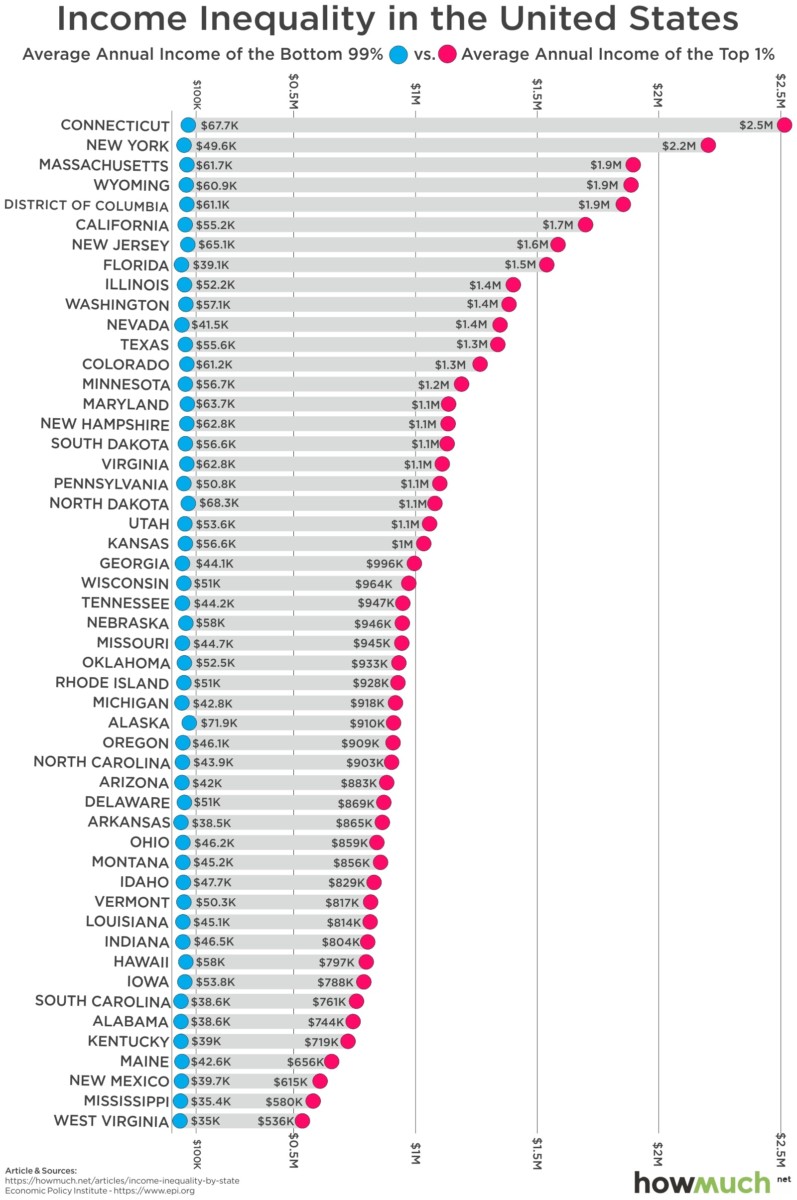
Here's a little factoid for us progressives to ponder: Income inequality appears to be generally worse in Blue States than Red ones:


What does that signify? There may be many explanations, but whatever they are, we Blues haven't done much to reduce inequality. We know that on a national level, but we can blame that on Republican resistance. But Massachusetts? New York? California? 


Wednesday, September 19, 2018

(Where the right is not wrong, part 3): White males are suffering

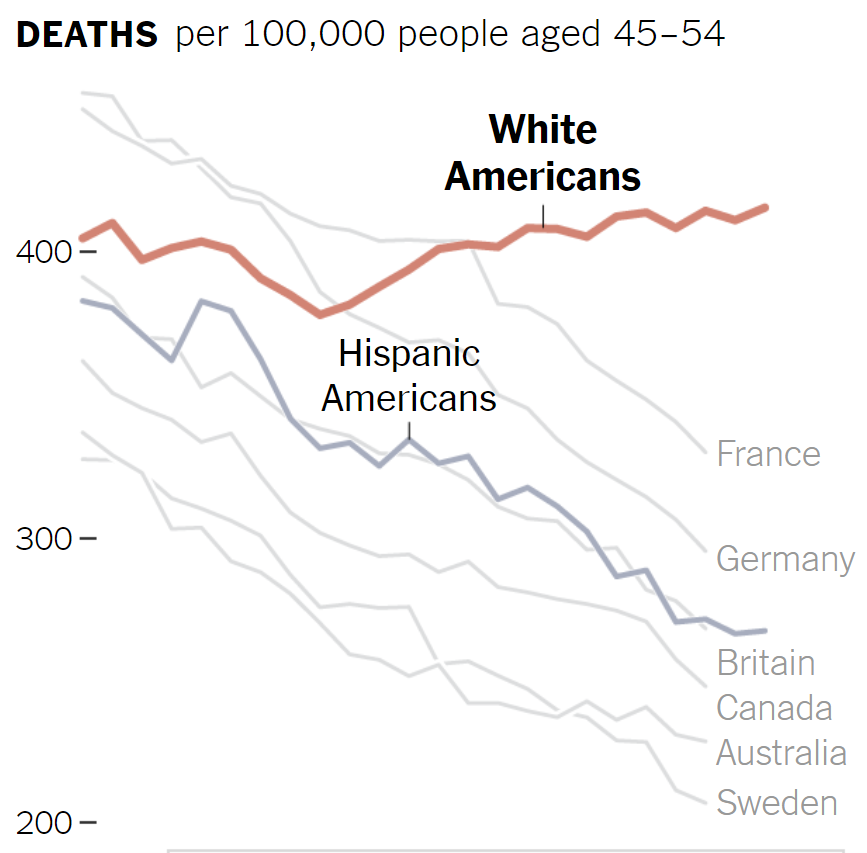
The Progressive Left among which I count myself, has shone a spotlight on the evils of racism, especially against African-Americans. Very few people now deny the long historical record of brutality, and a large majority even recognize the continuing injustices in the present day. But that focus has blinded us to the real suffering of whites and males. 
This burst into our consciousness – or should have burst – two years ago when Deaton and Case found that between 1999 and 2014, the death rate among white adults with a high school education rose by twenty-two percent. They trace the causes mostly to suicides and afflictions stemming from substance abuse: alcoholic liver disease and overdoses of heroin and prescription opioids. “Only H.I.V./AIDS in contemporary times has done anything like this,” Deaton commented.  If those words aren’t enough, here’s a picture:

.
The liberal response has been largely unsympathetic. We haven't paid much attention to this study or this group. Hillary Clinton largely ignored them in 2016. We often dismiss them as ignorant and uneducated. We would never say that about any other group – immigrants or blacks or muslims – because that would be victim-blaming. But we generally don’t see undereducated white males as victims: we see them as the beneficiaries of centuries of racism. Yet they apparently don’t feel like beneficiaries of anything, and they’re dying.
We do offer them money – we say our welfare-state programs will protect them from poverty. Then we are baffled when they don’t embrace us. Like Robert Frank in his popular book, we cannot figure out “What’s the matter with Kansas?” But we should know: money without respect is no balm. We do know that abstractly: the watchword of liberalism is respect. But we have this hole in our sight.
Conservatives don’t seem to have the answer either. Most of the hot spots of white mortality are in conservative, Republican areas – West Virginia, Kentucky, Kansas indeed, much of the West.
William Julius Wilson, perhaps the most important sociologist of black poverty of the past half century, made this point long ago: whatever the answer is, it has to include everyone. Solutions targeted at blacks will never work, because they divide the society, creating resentments that lead to exclusion rather than inclusion.  Whites need to be included in the solutions.

Monday, August 6, 2018

Winning is not enough

As a liberal, I am deeply upset by the direction of the country. But I don't think beating Trump will save us. I believe deeply that we have to do something harder: to build understanding across the political divide.

But I’m not getting much traction. Almost everyone on both sides believes it’s more important to win. They all think their view of the world is right, and that the future depends on their triumph.

I’m saying that victory, by itself, won’t do it. We need to demand more of ourselves.

I am personally offended by Trump actions almost every day, and I feel he is extremely dangerous for our future. I think he has to be stopped; it’s an emergency. He is destroying the foundations of our democracy, and indeed of the international world order that has slowly increased prosperity and safety for everyone for decades.

And yet, if all we do is to stop him, 40% of the country will be enraged and will battle back with every weapon they can find. In this kind of polarized environment, the rules of civilization no longer restrain people. Though I feel that the situation is so bad that we have to stop Trump almost no matter what it takes, the other side -- the solid 40% of Trump supporters -- feels just as passionate. This is how conflict spirals out of control.

Western democracies, after a long period of general accord on the principles of Keynesianism and the welfare state, have profoundly split. The populist wave, which has gained significant strength across the board, rejects the advances of the postwar period, is hostile to multiculturalism and globalization, and has little faith in existing governments. Populists feel they have ignored and marginalized for too long, and they are full of passionate intensity in their search for power.

Since these nations are, after all, democracies, we cannot ignore this backlash; nor should we. We liberals have not done the work of understanding the sources of the discontent. We are too quick to accept facile explanations that demean the populists and deny their legitimacy as citizens: we call them ignorant, racist, “deplorable.” They feel, with much justification, that if they lose this battle we will simply sweep them aside. They will fight with fury to prevent that, and they will continue the war even if they lose a battle.

It’s worth looking at history for lessons. Here’s one instructive contrast: After World War I the victorious Allies punished Germany and treated it with contempt; it rose rapidly from a crushing defeat to launch another wave of destruction. After World War II, by contrast, we helped Germany to rebuild, and major efforts were made to bring it back into the large European community; it soon became a major force for progress and liberalism.

Or we can look at our own Civil War: when the Union won, Abraham Lincoln pleaded for reconciliation in his Second Inaugural address: “We are not enemies, but friends. We must not be enemies. Though passion may have strained, it must not break our bonds of affection.” His assassination, however, unleashed a vengeful torrent of victors against victim – with the result that much of the South remains to this day alienated, hostile to the dominant liberal order.

We have to win, but we have to win in a way that promotes reconciliation. We have to call, as Lincoln did, on “the better angels of our nature” even in the midst of a battle that may determine the fate of the earth. We need to listen to our enemies, to understand their grievances, and to include them in building our common future. It demands hard work instead of facile triumph. But if that’s asking too much from us, we may not get a chance to build at all.

Wednesday, August 1, 2018

A theory of polarization: four frames

A brief statement of my theory of political polarization - supported by my recent survey. It does a good job of identifying the basic differences between Republicans and Democrats.
Four basic “frames”, or ways of seeing the social world, have emerged in the West over the last few hundred years. Each has a different focus:
  • Tradition: emphasizes shared traditions and beliefs, focusing heavily on churches.
  • Freedom: emphasizes individual liberty and responsibility, focusing on free markets.
  • System: sees society as a system of large institutions – corporations, unions, and government, guaranteeing stability and fairness.
  • Diversity: seeks full inclusion and interaction among different cultures.
These four frames capture key electoral divisions and show up strongly in my survey data. Tradition is the orientation of religious and culturally conservative Republicans, and Freedom that of more libertarian Republicans. On the Democratic side, System is the frame of “old” liberals who support the welfare state and unions, while Diversity is the more “progressive” frame within the party, focused on multiculturalism and racial justice.
The important thing is that these orientations are not fads or temporary products of political sloganeers, nor are they just personality types. They are competing visions of a good society that have emerged from a long arc of Western history.
The Traditional frame has characterized most human groups since the dawn of history. It believes that societies work only if everyone shares a basic sense of right and wrong across all domains of life. That sense must come from some combination of tradition and religion shared by all; and it has to be strongly inculcated in everyone, because failure to do so threatens the order. This shared belief provides strong stability and confidence: when you cross paths with others, you can be pretty sure that they will see things the same way you do and will act as you expect.
The problem with the Traditional view is that it doesn’t give a way of dealing with people who don’t share your religion and traditions. So when Traditionalistic groups have to deal with outsiders, they usually fight. The religious wars of the 16th century in Europe were so bloody that societies at last moved to the next step: an agreement to tolerate differences and to accept individual freedom.
The Freedom frame emerged, in the West at least, during the 17th and 18th centuries with an acceptance of the moral autonomy of individuals – a centerpiece of the emergent Protestant faiths – and, with it, the importance of personal responsibility. From this perspective, it doesn’t matter what tradition or religion others come from: they can do whatever they want in private. All that matters is that they follow a few basic rules in public that we have agreed to – a “social contract.” Otherwise we stay out of each other’s way, live and let live.
The early modern era combined the Tradition and Freedom frames: people maintained their traditions and religion in their private spheres, and made impersonal deals in their public lives. These two frames have now allied in the Republican party. The alliance is not always comfortable: libertarians, who emphasize Freedom, are often in tension with the Traditionalist wing of the party. Nevertheless, both represent a “conservative” orientation in that they reflect views of society that have long histories and fully-developed institutions of social order.
The Industrial revolution complicated things further. As society became more complex, big organizations began to take space from markets. Big businesses were able to produce efficiently on larger scales than pure markets; and government grew to regulate and coordinate them. A view developed that saw society not as atomistic individuals and tribes making deals with each other, but as systems of rules and organizations. Nations throughout the West organized around three key institutions that grew rapidly in the mid-20th century: corporate bureaucracies, “big government,” and unions. This "System" view was the framework for thirty years of great prosperity and social advances throughout the West after World War II..
Starting in the late 1960s, however, this view lost support: confidence in those big institutions has declined sharply throughout the advanced nations, and “bureaucracy” has come to be seen as a bad word rather than a good one. In its place, there has developed a frame around Diversity. It emphasizes the value of cultural differences and seeks to eliminate the status differences that have kept some groups subordinated to others. Personal identities have become much more fluid – less based on traditional roles, more constructed from engagement with a range of others. As the newest of the four frames, it is still an idea more than a program, with the least experience in actually building large-scale societies.
In the Republican party, the tension between Tradition and Freedom sometimes bursts out, for instance in battles over economic protectionism or around Traditionalists’ impulse to impose their moral codes. The Democratic party is often torn by tensions between the Sytem and Diversity views. Bernie Sanders, for instance – an old System guy, focused on government programs – has trouble connecting to the multiculturalists. Nevertheless, the two strands are broadly allied because they reflect views of society that have emerged only within the last century, and in many ways are not yet fully developed. Both are building their vision around partially-formed aspirations rather than concrete images from the past. The Diversity view, in particular, is still in an early stage, with many unsolved problems; it is more an impulse than a program.
These changes have caused much turmoil and disruption. Some parts of Western societies have responded “conservatively” – wanting to go back to the hybrid of Tradition and Freedom frames that marked the early Modern era, roughly the 17th to the mid-19th centuries in the West. The more urban and globalist groups have wanted to push forward in creating societies of greater participation and diversity, even when they don’t quite know how to do it. And that split has led to our current polarization. The contest between these basic perspectives will determine our future.

Friday, July 27, 2018

Have opinions shifted since the election?

I wanted to know whether all the brouhaha since the 2016 election has led to any fundamental shifts in views. The answer, in short, is: maybe a little; we should raise a caution flag but not send out the emergency rescue vehicles.

I conducted national surveys in  2014-15 for a study of trust, and ran another one last month (June), with a similar sampling method and some of the same items. The earlier surveys focused particularly on views of diversity. I was surprised to find at that time that there was near-consensual support for what I called “strong diversity” – not just tolerance, but belief in the value of active multiculturalism. Two of those items, which were  repeated in the new round, were:

  • People from other places and cultures help us to grow, we should learn from them.
  • People should be encouraged to celebrate their cultural, ethnic, religious, and linguistic differences.
In the first round, 78% agreed with the first and 83% with the second. I found this quite surprising: these items seemed to me to touch directly on the culture wars and the contested notion of multiculturalism. When I wrote them I expected a lot of negative responses. Yet it appeared they had in fact become very widely accepted as the right way to think and speak.

Some might object: Well, but this is just people saying what they think they ought to say, to avoid feeling guilty about their real beliefs. If that were the case, one might expect that Trump’s election would have taken the lid off: people might feel it was now ok to voice their real objections to multiculturalism.

The results suggest a little of this, but only a little. There was some decline on both the strong diversity items above: 4% on the first, 6% on the second. There was a 3% decline on “I expect the government to ensure that diverse people are included and respected.” None of these proves much alone, but together they suggest a very small reduction in endorsement of multiculturalism. Yet support for it remains very high: this is far from an unleashing of a torrent.These add to a sense of a small conservative shift, at least verbal.

There were similar decreases in some items on government activism: 3.5% that government should regulate market forces; 2% on wanting government to ensure that everyone is provided for. These add to the impression of a quite small conservative shift.

Altogether, I think the Trump phenomenon has enabled some people with conservative leanings to express more openly their skepticism about multiculturalism. But it has not much shifted the center of gravity, which continues – again, to my surprise – to endorse, the multiculturalist view at an over 75% rate.

Two items of a different sort do trouble me. Two of the biggest declines were a 9% drop in “We all depend on each other, so we have work together,” and a 7% drop in “It is important to try to understand people we don't agree with.” When I put these together with a lot of other evidence, I see gathering evidence of increasing polarization – not wanting to deal with political disagreement.

One way of reading the whole pattern (including some evidence I haven’t detailed here) is that both liberals and conservatives are moving a bit towards more openness in their views, less willing to shade their opinions to meet a perceived unifying consensus. Openness is good, but rejection of a desire to seek agreement is, I think very dangerous. These data don’t show a crisis, but a kind of polarization that – as I have indicated in other posts – could be a grave threat to our democracy.


Sunday, July 22, 2018

Why Trump supporters stick with him


Liberals are continually amazed that Trump's supporters stick with him no matter what outrages he commits: we keep thinking, "This time he's gone too far," and we keep being wrong. Here's why:

1. Trump voters, in the main, think the system is rigged against them.

81% of Trump voters say that “Compared to 50 years ago, life for people like me is worse” – (vs only 19% of Clinton voters).

2. When people feel the system is rigged against them, they vote for whoever promises to smash it.

That’s Trump. And he’s doing quite a good job of smashing it. If that’s what you want, he’s your man.

3. When those who are identified with the rigged system -- that is, us -- act outraged, that means – for Trump voters – that he must be doing the right thing.

Therefore: The more outraged we are, the more they support him.

Monday, July 16, 2018

Where the Right is not wrong, part 3: The value of personal responsibility

Below: Part 1: Experts don't know everything
              Part 2: regulations are often burdensome

One of the weird things that result from polarization is that perfectly sensible ideas become distorted  by association with one side. The Right has taken ownership of the idea of “personal responsibility”. For the Left, that now smells of a cover for not wanting to help those in need. Reds seek to cut programs like welfare because, from their perspective, they want to encourage personal responsibility; from our Blue point of view, that just leaves the poor in the lurch and robs  them of opportunity. We believe government has a responsibility to help, and we do not believe that voluntary charity from communities or individuals is adequate. This disagreement quickly spirals into mutual recriminations, with the Right accusing the Left of coddling the poor just to win votes and power, and the Left accusing the Right of covering avarice and heartlessness under a false value of responsibility.

But let's step back for a moment. Personal responsibility is something we all value. Blues hope as much as Reds that our kids will learn this value. None of us believes that a good society is one in which people laze around waiting for government handouts. We all want a society in which people are engaged in meaningful work and can support their families and communities.

And we should recognize that none of us really knows how to get there. Even if government programs are critical for helping the disadvantaged - which we Blues do believe - we haven't solved the problem of what happens after that. There have of course been many theories and experiments in transitioning people from welfare, but I think it's fair to say that none has been a ringing success. But neither has relying on local community and personal responsibility.
The sociological view is that we need both. Government cannot operate effectively without support from communities, and communities are not sufficient to deal with the problems of complex societies without government. Is it so hard to keep both things in mind at once?

We do know that the Great Society programs of the 1960s and 1970s have not succeeded in improving the lives of many poor and minority people. Some Blues blame it on racism, which is a rather vague category; but even if it's true, that's exactly the point. Regulations cannot by themselves overcome racism or other forms of social resistance. Regulations work only when they operate together with growing social consensus.

We if the Left don't have much to say about how to build such a consensus. Faced with crises in government-based welfare programs, we generally stick to a one-note reply: do more of the same - increase the force and scope of the regulations. But much evidence indicated that this only increases the force and scope of the resistances and evasions. We have paid far too little attention to complementary strategies of community mobilization, especially among whites and the more affluent. And we have consistently underestimated the difficulty of building self reliant communities among the disadvantaged.

It certainly seems clear that personal responsibility is not enough: benevolence from the dominant community, and preaching the value of self reliance to the poor, are inadequate responses to the severe issues of inequality and poverty. But community and self reliance are good and necessary and should be part of the conversation.